

 An MCA cash advance is a type of loan offered by a Merchant Cash Advance company to a business in exchange of a percentage of their future sales. But, what happens if you can’t make payments in time? Can an MCA company legally freeze your business bank account?
Let’s explore this matter further.
Key Takeaways
- An MCA company generally cannot secure a bank account simply because you missed a payment. A freeze typically requires legal authority, such as a court judgment, restraining notice, bank levy, or another enforceable mechanism.
- Confessions of Judgment (COJs) can create serious risks, but their enforceability depends on state law. In California, for example, judgments by confession are generally unenforceable under California law, making it important to review the MCA agreement and applicable state regulations.
- Act quickly if an MCA lender threatens to freeze your account or has already restricted your funds. An attorney may be able to challenge an unlawful freeze, negotiate payment adjustments or reconciliation, and determine whether restructuring or bankruptcy is appropriate.
If you obtained an MCA loan or are thinking about requesting one, you may be wondering if this company may legally freeze your bank account if you fall behind on payments. The short answer is “yes”, but under specific legal conditions.
An MCA company usually obtains money from daily or weekly withdrawals directly from your bank account or credit card income. However, they cannot unilaterally freeze your bank account just because you missed a payment. Nonetheless, the situation may change if they obtain authorization or a court order.
How can MCA funders freeze or restrict bank accounts
There are mainly two ways Merchant Cash Advance companies can freeze or restrict a business’ bank accounts:
- Through a lawsuit: If your business defaults and fails to make MCA payments, the MCA company can sue your business for breach of contract, and if they win a court judgment, they can obtain a legal order that will allow them to issue a restraining notice or bank levy to your bank. This, in consequence, will freeze your funds.
- Confession of Judgment: Also known as COJ for its initials, it is a clause often included in contracts, which waives your right to a trial, allowing the MCA lender to obtain a court judgment immediately and have your accounts frozen without notice.
Is Confession of Judgment (COJ) allowed in California?
 Even though COJ is allowed in many states, in others, such as New York and California, it is strictly prohibited. Effective January 1, 2023, California updated the Code of Civil Procedure (CCP) Section 1132 to explicitly make judgments by confession unenforceable and inadmissible in any California Superior Court.

MCA lenders can serve a restraining notice to your bank
Another way an MCA company can freeze or restrict your account is by serving a UCC lien notice or restraining notice to third parties, which can include your bank or payment processor.
According to Cornell Law School, “UCC Financing Statement (usually called a UCC-1 Form) is a form that creditors file with states in which they have a security interest in a debtor’s personal property. The financial statement serves a similar purpose as recording a deed for real property.”
This is possible thanks to the filing of a UCC-1 financing statement that gives MCA lenders a security interest in your receivables.
Lenders can claim default
If you decide to unilaterally block MCA companies’ ACH transfers without previously discussing an adjustment plan, the lender can claim default and start rapid enforcement tactics.
What can you do if you’re facing a freeze?
 First of all, contact an attorney that is well-versed on MCA debt relief. They can file emergency motions to vacate unlawful freezes, challenge invalid COJs, vacate illegal restraints, and help you navigate through the way out of an MCA financial loan and/or debt.
It is also important that you review the contract terms on your MCA agreement. If your business revenue has dropped, you may be entitled to a payment reconciliation without having to default. This is a good idea before an ACH block takes place and also helps prevent bank freezes.
When to consider filing bankruptcy amidst MCA debt?
Whether to consider bankruptcy depends on the type of debt you have, your income, and whether your financial hardship is temporary or permanent. Either way, a bankruptcy attorney can help you decide if this is the most appropriate path to take.
Because bankruptcy is a major legal decision with long-term impacts on your credit, it is typically considered a last resort—but it can also provide immediate legal relief (an “automatic stay”) that halts wage garnishments, lawsuits, and aggressive collection tactics like MCA bank freezes.
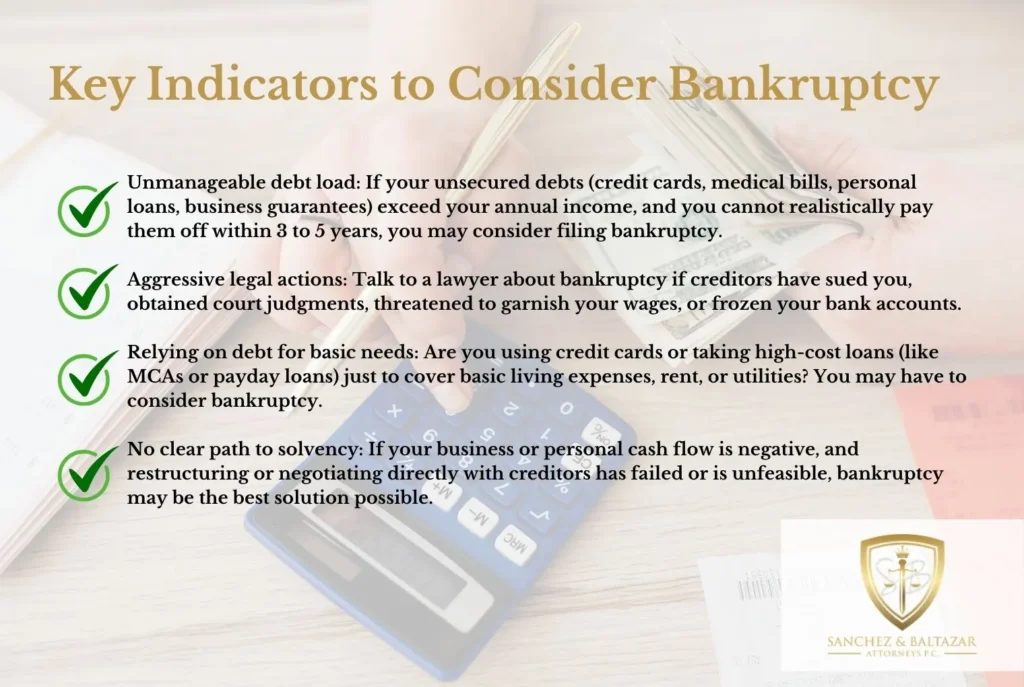
Key indicators to consider bankruptcy
The following indicators may give you a better idea if you need to file bankruptcy or not:
- Unmanageable debt load: If your unsecured debts (credit cards, medical bills, personal loans, business guarantees) exceed your annual income, and you cannot realistically pay them off within 3 to 5 years, you may consider filing bankruptcy.
- Aggressive legal actions: Talk to a lawyer about bankruptcy if creditors have sued you, obtained court judgments, threatened to garnish your wages, or frozen your bank accounts.
- Relying on debt for basic needs: Are you using credit cards or taking high-cost loans (like MCAs or payday loans) just to cover basic living expenses, rent, or utilities? You may have to consider bankruptcy.
- No clear path to solvency: If your business or personal cash flow is negative, and restructuring or negotiating directly with creditors has failed or is unfeasible, bankruptcy may be the best solution possible.
Talk to SB Legal if you are struggling with MCA debt and are unsure if bankruptcy is the solution for you. Our professional Merchant Cash Advance lawyer offers a free initial consultation; Contact us today!
Summary
A Merchant Cash Advance company may be able to freeze or restrict a business bank account under certain legal circumstances, but it generally cannot do so merely because a business has missed an MCA payment. However, depending on the circumstances, enforcement may involve a lawsuit and court judgment, a restraining notice, a UCC lien, or other contractual and legal remedies.
Business owners facing MCA debt should review their agreements carefully and seek legal advice before blocking ACH payments or taking other unilateral action. Early intervention may help prevent aggressive collection tactics and provide options such as reconciliation, restructuring, negotiation, or, when appropriate, bankruptcy protection.
Frequently Asked Questions About MCAs And Frozen Bank Accounts
Can an MCA company take money directly from my business bank account?
An MCA agreement may authorize the funder to make recurring ACH withdrawals from your business bank account. However, the lender’s ability to take additional funds or restrict your account after a default depends on the contract, applicable law, and whether the lender has obtained additional legal authority.
What should I do if an MCA company has already frozen my bank account?
Contact an attorney as soon as possible and provide them with your MCA agreement, bank statements, notices from the lender, and any court documents you received. Depending on the circumstances, an attorney may be able to challenge the freeze or seek emergency relief while helping you address the underlying MCA debt.
Can bankruptcy stop an MCA bank freeze?
Bankruptcy may provide an automatic stay, which can halt certain collection actions, lawsuits, and enforcement proceedings. However, whether it can stop or reverse a particular bank freeze depends on the circumstances and the nature of the MCA debt. A bankruptcy attorney can evaluate whether bankruptcy is an appropriate option.