

 Credit card debt can become a serious financial burden, especially when interest, late fees, and collection charges continue accumulating. However, creditors and debt collectors do not have unlimited time to take legal action against consumers who fail to pay their balances.
Understanding the statute of limitations on credit card debt can help you determine whether a creditor still has the legal right to sue you for an unpaid balance. In California, the general statute of limitations for credit card debt is four years. Once this period expires, creditors generally cannot file a lawsuit to collect the debt.
But when does the four-year countdown actually begin? Can a debt collector sue you after several years of inactivity? Does making a partial payment restart the clock?
This chronological guide explains what is the statute of limitations on debt, how California law applies, and how a bankruptcy attorney can help you protect your financial future.
Key Takeaways
- The statute of limitations does not erase your debt. Even after the four-year deadline expires in California, the unpaid credit card balance may still exist. However, creditors generally lose the ability to pursue a lawsuit to collect a time-barred debt.
- Debt collection lawsuits require immediate attention. If you receive a court summons, do not ignore it. Failing to respond can result in a default judgment, potentially allowing creditors to pursue collection remedies despite your available legal defenses.
- Bankruptcy may offer relief before the statute of limitations expires. Chapter 7 and Chapter 13 bankruptcy can provide different solutions for overwhelming credit card debt. A bankruptcy attorney can evaluate your financial situation and help determine the most appropriate strategy.
1. Understanding the Statute of Limitations on Credit Card Debt
The statute of limitations on debt is a legal deadline that determines how long a creditor has to file a lawsuit to recover money owed by a borrower.
In California, most credit card agreements are considered written contracts. Under California Code of Civil Procedure Section 337, creditors generally have four years to file a lawsuit involving a written contract.
This means that if you stop making payments on your credit card, the creditor cannot wait indefinitely before taking legal action.
The statute of limitations on credit card debt applies to claims involving:
- Unpaid credit card balances.
- Outstanding credit card payments.
- Breach of written credit card agreements.
- Certain collection claims involving open book accounts or accounts stated.
The four-year period is also generally applicable when a debt is sold to a collection agency or debt buyer. Transferring ownership of a debt does not automatically give the new owner additional time to sue.
2. The Chronological Timeline: When Does the Four-Year Clock Start?
One of the most important questions consumers ask is: How long is statute of limitations protection available, and when does the countdown begin?
Although California generally provides a four-year period, determining the exact starting date requires examining the credit card agreement, payment history, and legal basis of the creditor’s claim.
Here is a simplified chronological example.
Month 1: You Miss Your First Credit Card Payment
Suppose you have a credit card balance of $8,000 and stop making payments.
When the payment becomes due and you fail to pay, you may breach your credit card agreement. This can trigger the beginning of the statute of limitations period.
The precise accrual date depends on the circumstances and the legal claim being pursued.

Months 2–6: The Creditor Begins Collection Efforts
The credit card company may begin contacting you about the outstanding balance.
You might receive:
- Payment reminders.
- Late-payment notices.
- Collection letters.
- Telephone calls from creditors.
- Notifications that your account has been transferred to a collection agency.
At this stage, the creditor generally still has time to pursue legal action.
Importantly, receiving collection notices does not automatically restart the statute of limitations.
Months 7–12: Your Account May Be Charged Off
If your account remains unpaid, the credit card company may eventually charge off the debt.
A charge-off is an accounting procedure that generally occurs after an extended period of nonpayment. It does not mean the debt has disappeared or that you are no longer legally responsible for it.
The creditor may continue collection efforts or sell the account to a debt buyer.
Important: The charge-off date does not automatically establish a new four-year statute of limitations period.
Years 2–3: Debt Collectors May Continue Pursuing Payment
During this period, creditors or collection agencies may continue attempting to recover the outstanding balance.
A debt buyer may also purchase your account and attempt to collect the money.
However, the original timeline generally continues to apply. Selling or transferring the debt does not automatically restart the statute of limitations.
Consumers should keep copies of their original credit card agreements, statements, payment records, and collection notices.
These documents can become important if a creditor eventually files a lawsuit.
Year 4: The Statute of Limitations May Expire
Once the applicable four-year period expires, the debt generally becomes time-barred under California law.
Under California Code of Civil Procedure Section 337(d), a person cannot bring a lawsuit, arbitration, or other legal proceeding to collect a debt after the applicable limitation period has expired, subject to the statutory rules.
This is an important consumer protection because it prevents creditors from pursuing certain old debts through the courts indefinitely.
However, expiration of the statute of limitations does not necessarily eliminate the debt itself.
A collector may still attempt to contact you about an unpaid balance, subject to applicable debt collection laws.
3. Can a Debt Collector Sue You After Four Years?
Generally, no. If the statute of limitations has expired, a creditor cannot legally bring a covered collection lawsuit in California.
However, consumers should understand an important distinction between an expired debt and a discharged debt.
A time-barred debt is a debt for which the creditor has lost the right to pursue a lawsuit under the applicable statute of limitations.
A discharged debt is a debt that has been legally eliminated through a bankruptcy proceeding.
These are two different legal situations.
Under federal debt collection regulations, third-party debt collectors are prohibited from bringing or threatening to bring legal action to collect time-barred consumer debt.
Nevertheless, you should never assume that a lawsuit is invalid simply because the debt appears to be more than four years old.
The creditor may dispute the starting date, claim that the applicable period was extended, or rely on a different contractual provision.
If you receive a Summons and Complaint, you should review the documents immediately and consider obtaining legal assistance.
Ignoring a lawsuit can result in a default judgment, even when you may have a valid statute of limitations defense.
4. Can Making a Payment Restart the Statute of Limitations?
This is one of the most important issues involving the statute of limitations on credit card debt.
Consumers sometimes receive calls from collection agencies offering reduced payments or settlement arrangements on old accounts.
Before accepting an offer or making a payment, understand the potential legal consequences.
California Code of Civil Procedure Section 360 addresses written acknowledgments, promises to pay, and certain partial payments.
Under this provision, a qualifying payment on a promissory note may restart the limitations period if made before the original period expires. A written acknowledgment or promise to pay can also have legal consequences.
However, the law distinguishes between extending an existing claim and reviving a claim that has already expired.
A payment alone does not revive an already time-barred cause of action under Section 360.
Because credit card accounts are not necessarily treated the same as promissory notes, the specific circumstances matter.
If you are contacted about an old credit card balance, avoid making assumptions about whether a payment or written agreement will affect your legal rights. Consult an attorney before agreeing to new payment terms.
5. Is There a Statute of Limitations on Debt Sold to Collection Agencies?
Yes. Selling a debt does not automatically eliminate or reset the original statute of limitations.
For example, imagine that you owe $5,000 to a credit card company. After several months of nonpayment, the company sells the account to a debt buyer.
The new company may contact you, demand payment, or even threaten legal action.
However, the debt buyer generally inherits the existing legal limitations applicable to the debt. It does not automatically receive another four years simply because ownership has changed.
Debt buyers must also establish that they have the legal right to collect the debt.
If they file a lawsuit, they may need to demonstrate:
- That the original debt existed.
- That you are legally responsible for the balance.
- That they acquired ownership of the account.
- That the amount claimed is accurate.
- That the lawsuit was filed within the applicable statute of limitations.
If the debt buyer cannot establish these elements, you may have additional defenses against the collection lawsuit.
6. What Happens If You Are Sued for Time-Barred Credit Card Debt?
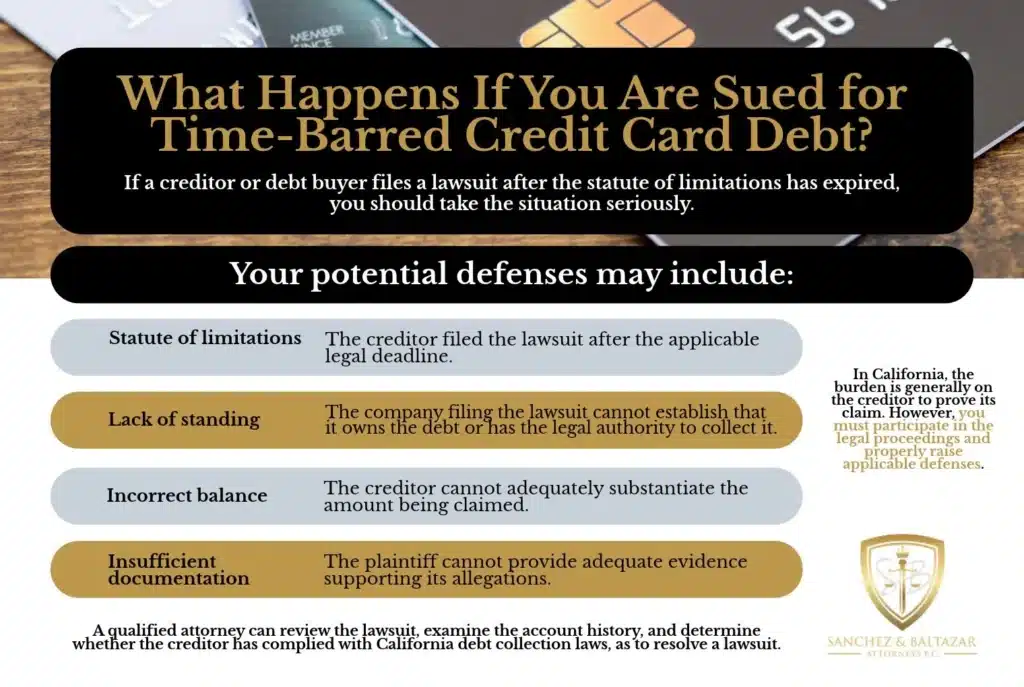
If a creditor or debt buyer files a lawsuit after the statute of limitations has expired, you should take the situation seriously.
Even if you believe the debt is too old to be legally enforceable, you must respond appropriately to the court proceedings.
Your potential defenses may include:
- Statute of limitations: The creditor filed the lawsuit after the applicable legal deadline.
- Lack of standing: The company filing the lawsuit cannot establish that it owns the debt or has the legal authority to collect it.
- Incorrect balance: The creditor cannot adequately substantiate the amount being claimed.
- Insufficient documentation: The plaintiff cannot provide adequate evidence supporting its allegations.
In California, the burden is generally on the creditor to prove its claim. However, you must participate in the legal proceedings and properly raise applicable defenses.
A qualified attorney can review the lawsuit, examine the account history, and determine whether the creditor has complied with California debt collection laws, as to resolve a lawsuit.
7. How a Bankruptcy Attorney Can Help With Credit Card Debt
 Understanding the statute of limitations on debt is important, but waiting for the four-year period to expire is not always the best financial strategy.
If you have multiple credit cards, outstanding loans, collection accounts, or lawsuits, bankruptcy may provide a more comprehensive solution.
A bankruptcy attorney can evaluate your financial situation and determine whether filing for Chapter 7 or Chapter 13 bankruptcy makes sense.
Chapter 7 Bankruptcy: Eliminating Eligible Credit Card Debt
Chapter 7 bankruptcy may allow qualifying consumers to eliminate unsecured debts, including many credit card balances.
Once a bankruptcy petition is filed, the automatic stay generally prevents creditors from initiating or continuing most collection lawsuits, making collection calls, or pursuing other collection activities.
After a successful bankruptcy proceeding, eligible credit card debts may be discharged.
This can provide significant financial relief for individuals who cannot realistically repay their outstanding balances.
However, eligibility depends on several factors, including income, assets, and applicable bankruptcy requirements.
Chapter 13 Bankruptcy: Creating a Manageable Repayment Plan
Chapter 13 bankruptcy may be an option for individuals who have regular income but need additional time to repay their debts.
Instead of immediately liquidating eligible assets, Chapter 13 allows qualifying debtors to propose a court-supervised repayment plan, generally lasting three to five years.
Depending on the circumstances, some unsecured debt may remain unpaid at the end of the plan and qualify for discharge.
This option may be particularly useful for individuals who want to protect certain assets while addressing overwhelming financial obligations.
Defending Against Debt Collection Lawsuits
A bankruptcy attorney can also help determine whether filing for bankruptcy is appropriate when a creditor has already initiated legal proceedings.
Depending on the circumstances, filing bankruptcy may trigger the automatic stay and temporarily stop most collection litigation.
An attorney can evaluate whether bankruptcy offers a more effective solution than negotiating with creditors or defending individual collection lawsuits.
The goal is not simply to address one credit card balance but to develop a financial strategy that provides long-term relief.
8. Protect Your Rights Before Credit Card Debt Becomes a Bigger Problem
Knowing the answer to the question, “What is the statute of limitations on debt?” can help you understand your legal rights when dealing with creditors and collection agencies.
In California, the general statute of limitations for credit card debt is four years. However, calculating the deadline requires examining the account history, contractual terms, applicable law, and any events that may affect the limitations period.
If you are struggling with unpaid credit cards, receiving collection notices, or facing a debt collection lawsuit, you do not have to navigate the situation alone.
A bankruptcy attorney can review your financial circumstances, explain your available legal options, and help you determine whether bankruptcy or another debt relief strategy is appropriate.
Taking action early can help you avoid unnecessary legal complications and work toward a more stable financial future. Contact SB Legal for a free initial consultation. Call us at: (760) 302-4652.
Frequently Asked Questions
Does credit card debt disappear from my credit report after the statute of limitations expires?
No. The statute of limitations and credit reporting deadlines are separate legal matters. Generally, negative information related to an unpaid credit card account can remain on your credit report for up to seven years from the date of the delinquency that led to the account’s collection or charge-off. The expiration of the statute of limitations does not automatically remove the account from your credit history.
Can a creditor garnish my wages over old credit card debt in California?
Generally, a creditor must first obtain a court judgment before garnishing your wages for unpaid credit card debt. If the creditor obtains a valid judgment, it may pursue wage garnishment subject to California’s applicable exemptions and limitations. Certain income sources and portions of your earnings may be protected by law.
What should I do if a debt collector cannot provide proof of my original credit card agreement?
You can request verification of the debt and supporting information identifying the original creditor, the outstanding balance, and the collector’s authority to collect. If you receive a collection lawsuit, you should also evaluate whether the plaintiff has sufficient evidence to establish its legal claims. A debt collection or bankruptcy attorney can help identify documentation problems and determine whether you have grounds to challenge the claim.