

 Petty theft vs grand theft in California. The legal difference generally depends on the value of the property taken, the circumstances of the alleged offense, and the applicable state law. Although both involve unlawfully taking someone else’s property, the classification of the crime can significantly affect the potential penalties, criminal record, and long-term consequences for the accused.
In California, these offenses are commonly referred to as grand theft and petty theft and understanding the difference between grand theft and petty theft in California is essential if you are facing theft charges or want to understand your legal rights after an arrest.
A criminal conviction can result in fines, probation, jail time, and other consequences. However, the specific penalties depend on the facts of the case, the value and type of property involved, the defendant’s criminal history, and whether aggravating circumstances apply.
Key Takeaways
- Theft charges depend on more than the value of the property. The type of property, the circumstances of the alleged offense, the evidence of intent, and applicable statutory exceptions can all influence whether a theft is classified as petty theft or grand theft in California.
- A theft conviction can have consequences beyond the criminal sentence. Depending on the offense and the defendant’s circumstances, a conviction may affect employment opportunities, professional licensing, housing applications, and other aspects of daily life.
- Early legal representation can help protect your rights. A criminal defense attorney can identify weaknesses in the prosecution’s case, evaluate potential defenses, and pursue an appropriate resolution based on the evidence and applicable law.
What Is the Legal Difference Between Grand Larceny and Petty Theft?
The primary distinction between grand larceny and petty theft is the seriousness of the offense and, in many jurisdictions, the value of the property allegedly stolen.
Petty theft generally refers to stealing property valued below a legally established threshold. It is typically classified as a misdemeanor, although the precise consequences vary by state and the circumstances of the offense.
Grand larceny, also called grand theft in California, generally involves property that meets or exceeds a specified dollar threshold or property that falls into a special legal category. Depending on the jurisdiction, grand theft may be charged as a misdemeanor or a felony.
The terms larceny and theft are often used interchangeably in everyday language. However, the terminology and legal definitions vary across states. California law primarily uses the term theft and distinguishes between petty theft and grand theft.
What Is the Dollar Threshold for Grand Theft in California?
 Under California Penal Code Section 487, grand theft generally applies when the value of the property taken exceeds $950, subject to statutory exceptions and special categories of property.
California Penal Code Section 488 generally defines petty theft as theft that does not amount to grand theft.
The basic distinction is:
- Petty theft: Property valued at $950 or less, assuming no special provision makes the offense grand theft.
- Grand theft: Property valued at more than $950, subject to the applicable statutory rules and exceptions.
The value of the property is not always the only factor. California law also recognizes certain forms of grand theft based on the type of property or the circumstances of the taking, even when the ordinary dollar threshold is not met.
For example, specific provisions address certain agricultural products, firearms, and other property. The applicable statute must be reviewed to determine the proper classification.
Another important consideration is how the property is valued. The prosecution generally must establish the legally relevant value of the property, which may require evidence about its fair market value at the time of the theft. Disputes over valuation can affect whether a charge qualifies as petty theft or grand theft.
Petty Theft vs. Grand Theft in California: Sentencing Differences
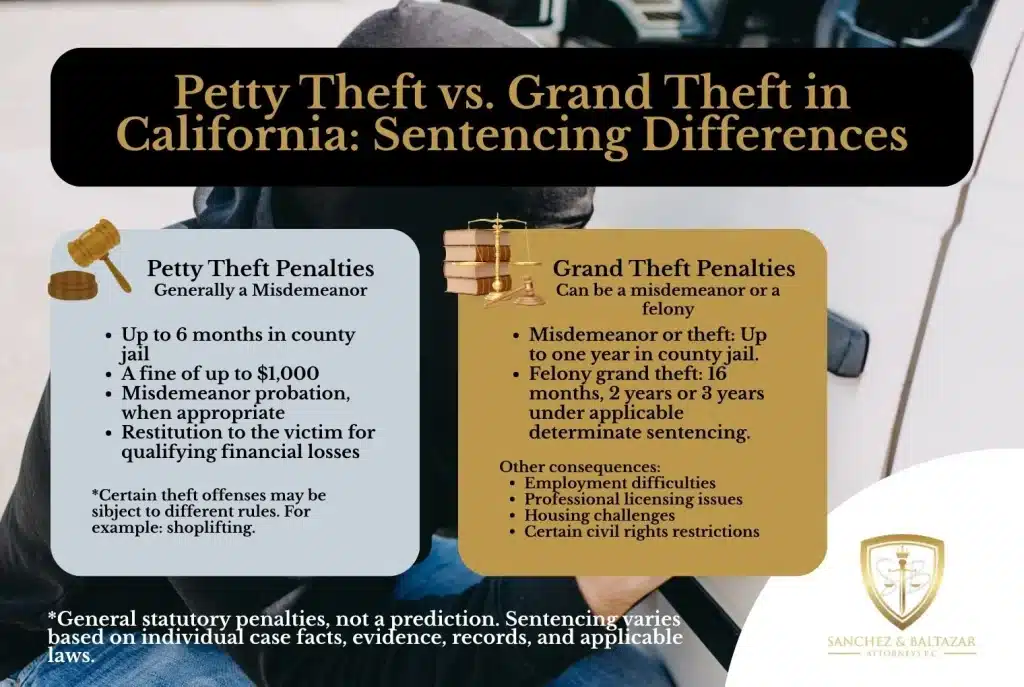
The distinction between petty theft and grand theft can substantially affect the penalties a defendant faces.
Petty Theft Penalties
Under California Penal Code Section 490, petty theft is generally a misdemeanor punishable by:
- Up to six months in county jail.
- A fine of up to $1,000.
- Misdemeanor probation, when appropriate.
- Restitution to the victim for qualifying financial losses.
These are general statutory penalties, not a prediction of the sentence in an individual case. Eligibility for alternative sentencing, the defendant’s record, the facts of the offense, and other applicable laws can influence the outcome.
Certain theft offenses may be subject to different rules. For example, shoplifting has its own statutory definition under California law, and other provisions can affect the applicable charge or penalty.
Grand Theft Penalties
Grand theft is more serious because it can be charged as either a misdemeanor or a felony under California Penal Code Section 489, depending on the circumstances and applicable statutory provisions.
Grand theft punishable as a misdemeanor may carry up to one year in county jail.
When charged as a felony, grand theft can carry a sentence of 16 months, two years, or three years under the applicable determinate sentencing provisions. The precise sentencing range depends on the charge, the relevant statute, and the circumstances of the case.
A felony conviction may also have consequences beyond incarceration, including difficulties with employment, professional licensing, housing, and certain civil rights.
Not every grand theft allegation results in a felony conviction. The facts, available evidence, applicable charging provisions, and possible defenses all matter when determining the outcome.
Can Grand Theft Be Charged as a Misdemeanor or a Felony?
Yes. California law allows certain grand theft offenses to be charged as either misdemeanors or felonies. These offenses are commonly called wobblers.
When a charge is eligible for this treatment, the prosecutor’s initial charging decision and the court’s determination can affect whether the case proceeds as a misdemeanor or felony. The defendant’s criminal history, the value of the property, the nature of the alleged conduct, and other relevant circumstances may influence those decisions.
An experienced criminal defense attorney can review whether the alleged conduct satisfies the elements of grand theft, challenge the prosecution’s valuation evidence, and identify legal or factual issues that could affect the charge.
What Factors Can Affect a Theft Charge?
 The value of the property is important, but it is not the only factor that can influence the classification and outcome of a theft case.
Relevant considerations include:
- The type of property: Certain property categories may be covered by special statutory provisions.
- The circumstances of the alleged theft: The way the property was obtained can affect which offense applies.
- The evidence of intent: Theft offenses generally require proof of the intent specified by the applicable statute.
- The defendant’s criminal history: Prior convictions can affect charging decisions, sentencing, and eligibility for certain alternatives.
- The available evidence: Surveillance footage, witness statements, receipts, ownership records, and valuation evidence can all matter.
- Potential restitution: The financial loss claimed by the alleged victim may be relevant to resolving the case, although restitution does not automatically determine the legal classification.
A careful review of these factors can help determine whether the charge is legally supported and what options may be available to the defense.
How Can a Criminal Defense Attorney Help With Grand Theft or Petty Theft Charges?
Facing a theft accusation can be stressful, especially when a charge could lead to jail time, a felony record, or lasting consequences for your career and personal life. A criminal defense attorney can help you understand the allegations, evaluate the evidence, and develop a defense strategy tailored to your circumstances.
1. Evaluating the Evidence
A theft lawyer can examine the prosecution’s evidence, including surveillance footage, witness statements, transaction records, and police reports. The attorney can identify inconsistencies, challenge unreliable testimony, and determine whether the evidence establishes the required elements of the alleged offense.
2. Challenging the Property’s Value
Because the value of the property can determine whether an allegation qualifies as grand theft or petty theft, a defense attorney can scrutinize the prosecution’s valuation evidence.
If the alleged value is disputed, the attorney may challenge the valuation method or present evidence supporting a lower value. Depending on the facts and applicable law, this could affect the charge’s classification.
3. Seeking a Reduction in Charges
When the evidence or applicable law supports a lesser offense, a criminal defense attorney can argue for a reduction from grand theft to petty theft or seek another appropriate resolution.
A reduction may limit potential penalties and reduce the long-term consequences of a conviction. However, the availability of this outcome depends on the specific facts, the evidence, and the law governing the charge.
4. Negotiating a Favorable Resolution
Depending on the case, a defense lawyer may negotiate with the prosecution regarding the charge, potential penalties, restitution, or eligibility for diversion or other alternatives when legally available.
The objective is to pursue the most favorable lawful outcome supported by the circumstances, whether through negotiation, a motion to dismiss, or trial.
5. Protecting Your Rights in Court
A criminal defense attorney can ensure that the accused understands the charges, receives appropriate legal representation, and has the opportunity to challenge the prosecution’s case.
If the case proceeds to trial, the attorney can contest the evidence, cross-examine witnesses, present a defense, and argue that the prosecution has not proved its case beyond a reasonable doubt.

What Should You Do If You Are Accused of Theft in California?
If you are accused of grand theft or petty theft, avoid assuming that the allegation automatically establishes guilt. The prosecution must prove the required elements of the charged offense, and the applicable dollar threshold is only one part of the legal analysis.
Consider preserving relevant receipts, transaction records, messages, and other evidence. Avoid discussing the details of the incident publicly, and consult a criminal defense attorney before making statements to investigators or deciding how to respond to the charges.
Early legal guidance can help you understand the potential consequences, identify possible defenses, and make informed decisions about your case.
Protect Your Rights With an Experienced Criminal Defense Attorney
The difference between grand larceny and petty theft can have a significant impact on the penalties you face and your future. In California, the distinction between grand theft and petty theft generally turns on the value and type of property involved, although special statutory rules can apply.
If you are facing theft charges, you do not have to navigate the criminal justice system alone. A knowledgeable criminal defense attorney can evaluate the evidence, challenge the prosecution’s allegations, explore opportunities to reduce the charge, and advocate for your rights throughout the legal process.
Obtaining legal advice early can help you understand your options and determine the best approach for your specific circumstances.
Contact SB Legal for a free initial consultation at (760) 302-4652. We are ready to help you navigate through this complicated situation if you are being accused of grand theft or petty theft in California.
Frequently Asked Questions
Can a theft charge be dismissed if the alleged victim does not want to press charges?
Not necessarily. In California, criminal prosecution is generally controlled by the prosecutor, not the alleged victim. Even if the victim withdraws a complaint or declines to cooperate, the prosecution may proceed if sufficient admissible evidence is available. However, the victim’s cooperation and the strength of the remaining evidence may affect the case.
Can someone be convicted of theft if they believed the property belonged to them?
A genuine and reasonable belief that the property belonged to the accused may provide a defense because theft generally requires a specific criminal intent. Whether this defense applies depends on the facts, including the circumstances surrounding possession of the property and the evidence of the defendant’s belief. A criminal defense attorney can evaluate whether the available evidence supports this argument.
Does paying restitution guarantee that a theft charge will be dismissed?
No. Paying restitution does not automatically result in dismissal of a theft charge or prevent a conviction. However, restitution may be relevant during plea negotiations, sentencing, or consideration for certain diversion programs when legally available. A defense attorney can explain how restitution may affect the available options in a particular case.