

 A wage garnishment can significantly reduce the amount of money you take home each pay period, but creditors generally cannot take an unlimited portion of your paycheck. Federal law establishes limits on how much of your disposable earnings can be garnished, while state law may provide additional protections that reduce the amount a creditor can collect.
So, how much can they garnish your wages? For most ordinary consumer debts, the federal limit is generally the lesser of 25% of your disposable earnings or the amount by which your disposable earnings exceed 30 times the federal minimum wage. However, the actual amount may be lower depending on your state’s law and the type of debt involved.
Key Takeaways
- A wage garnishment does not necessarily mean you will lose 25% of every paycheck. The amount depends on your disposable earnings, the type of debt, federal restrictions, and potentially more protective state laws.
- The type of debt can significantly affect garnishment rules. Credit card debt, child support, federal debts, and tax obligations can be subject to different collection procedures and limits.
- A wage garnishment should be reviewed promptly. Errors in the garnishment order, improper calculations, or failure to apply available exemptions can potentially affect how much is withheld from your paycheck. A wage garnishment attorney can review the order and explain your available legal options.
What Are Disposable Earnings for Garnishments?
One of the most important concepts in calculating a wage garnishment is disposable earnings.
What are disposable earnings for garnishments? Under the federal Consumer Credit Protection Act (CCPA), disposable earnings are the portion of your earnings remaining after deductions that are legally required to be withheld.
These required deductions can include:
- Federal income taxes
- State and local taxes
- Social Security taxes
- Medicare taxes
- Certain legally required retirement contributions
Voluntary deductions, such as some health insurance premiums, charitable contributions, union dues, or voluntary retirement contributions, generally are not deducted when calculating disposable earnings for purposes of the federal garnishment limit.
This distinction matters because the garnishment is generally calculated from disposable earnings, rather than simply taking a percentage of your gross paycheck.
How Much Can They Garnish Your Wages Under Federal Law?
For an ordinary consumer debt, federal law generally limits a creditor to the lesser of:
- 25% of your disposable earnings, or
- The amount by which your disposable earnings exceed 30 times the federal minimum hourly wage.
The federal minimum wage remains $7.25 per hour, making the 30-times calculation $217.50 per week.
For example, if your weekly disposable earnings are $500, 25% would be $125.
The calculation changes for people paid biweekly, semimonthly, or monthly because the federal thresholds are adjusted according to the length of the pay period. The Department of Labor currently lists the following federal thresholds for ordinary garnishments:
| Pay period | Disposable earnings | Federal amount that may generally be garnished |
| Weekly | $217.50 or less | $0 |
| Weekly | More than $217.50 but less than $290 | Amount above $217.50 |
| Weekly | $290 or more | Up to 25% |
| Biweekly | $435 or less | $0 |
| Biweekly | More than $435 but less than $580 | Amount above $435 |
| Biweekly | $580 or more | Up to 25% |
| Monthly | $942.50 or less | $0 |
| Monthly | More than $942.50 but less than $1,256.66 | Amount above $942.50 |
| Monthly | $1,256.66 or more | Up to 25% |
These are federal limits for ordinary garnishments. Your state may impose a lower limit.
Federal Limits vs. State Law Protections
The federal 25% rule is not necessarily the amount that a creditor can actually take from your paycheck.
Federal law allows states to provide greater protection for workers. When state law and federal law impose different garnishment limits, the Department of Labor explains that the law resulting in the smaller amount being garnished must generally be followed.
That means determining the garnishment disposable income available to a creditor requires more than simply multiplying your paycheck by 25%.
Depending on where you live, state law may:
- Protect a larger percentage of your wages
- Establish a higher minimum amount of income that must remain available to you
- Provide additional exemptions
- Limit how creditors can enforce judgments
- Provide hardship protections in certain circumstances
- In some jurisdictions, substantially restrict or prohibit garnishment for certain consumer debts
For example, some states have adopted protections that preserve more than the federal minimum. The National Consumer Law Center has identified states with enhanced protections involving either higher protected percentages, higher protected income thresholds, or both. State exemptions can change, so the law applicable to your particular state and situation should be reviewed rather than assuming the federal 25% limit applies automatically.
How Much Can a Credit Card Company Garnish Your Wages?
 A common question is: how much can a credit card company garnish your wages?
A credit card company generally cannot simply contact your employer and demand a portion of your paycheck. A wage garnishment for a typical consumer debt generally involves a legal process that results in an order requiring the employer to withhold money from the employee’s earnings.
If a creditor obtains a judgment and pursues wage garnishment, the federal CCPA generally limits an ordinary consumer-debt garnishment to the lesser of 25% of disposable earnings or the amount above the applicable 30-times-federal-minimum-wage threshold.
However, state law can provide greater protection. This is why the answer to “how much can a credit card company garnish your wages?” depends on factors such as:
- Your state
- Your disposable earnings
- Your pay frequency
- The type of debt
- Whether other garnishments are already in place
- Whether you qualify for a state exemption or hardship protection
What Is the Max Garnishment Amount?
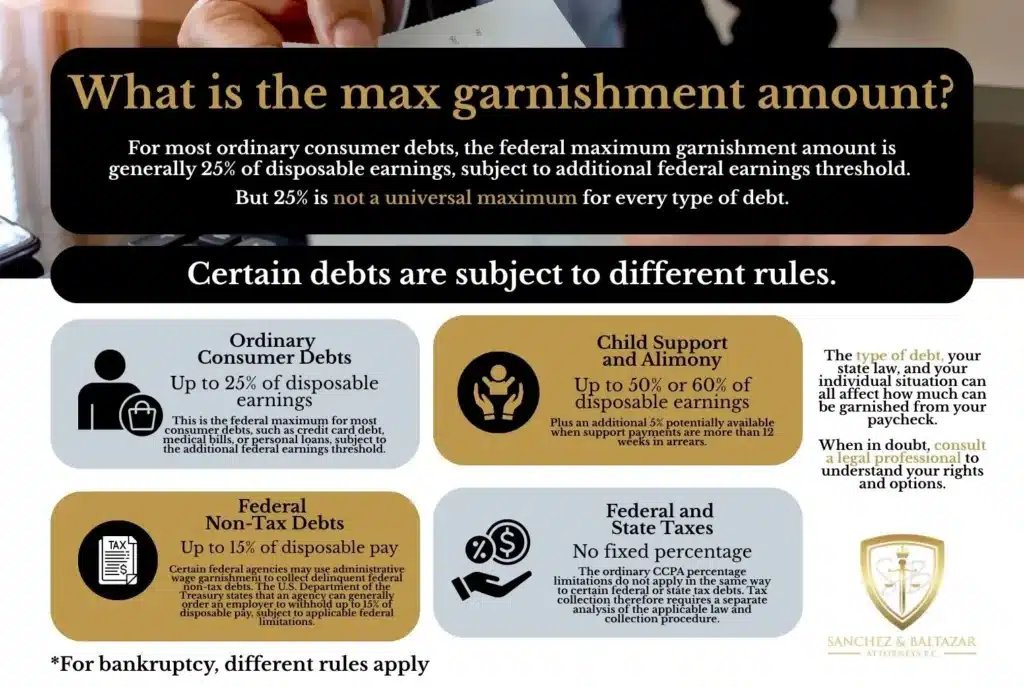
For most ordinary consumer debts, the federal maximum garnishment amount is generally 25% of disposable earnings, subject to the additional federal earnings threshold described above. But 25% is not a universal maximum for every type of debt.
Certain debts are subject to different rules.
Child Support and Alimony
Federal law permits substantially higher garnishments for qualifying support orders. Depending on whether the employee supports another spouse or dependent child, federal law generally permits up to 50% or 60% of disposable earnings, with an additional 5% potentially available when support payments are more than 12 weeks in arrears.
Federal Non-Tax Debts
Certain federal agencies may use administrative wage garnishment to collect delinquent federal non-tax debts. The U.S. Department of the Treasury states that an agency can generally order an employer to withhold up to 15% of disposable pay, subject to applicable federal limitations.
Federal and State Taxes
The ordinary CCPA percentage limitations do not apply in the same way to certain federal or state tax debts. Tax collection therefore requires a separate analysis of the applicable law and collection procedure.
Bankruptcy
Certain bankruptcy-related garnishments are also treated differently under federal law. A person facing wage garnishment may therefore need to consider whether bankruptcy protections or other legal remedies are relevant to their circumstances.
Can Multiple Creditors Garnish the Same Paycheck?
 Federal law establishes limits on the aggregate amount of ordinary garnishments in a workweek or pay period. The Department of Labor explains that the CCPA’s general limit applies regardless of how many garnishment orders an employer receives.
However, the priority of competing garnishments can depend on state and federal law, and certain types of debts have special priority rules.
This is another reason why simply assuming that every creditor can take 25% of your paycheck can lead to an incorrect calculation.
What Happens If a Wage Garnishment Is Taking Too Much?
If you believe that your paycheck is being garnished above the amount permitted by law, it may be possible to challenge the garnishment or assert an exemption.
Potential issues to investigate include:
- Whether the creditor obtained the required judgment or legal authority
- Whether you were properly served with the underlying lawsuit or garnishment documents
- Whether the creditor calculated the garnishment correctly
- Whether the employer is using the correct definition of disposable earnings
- Whether your state provides greater wage protections
- Whether you qualify for a hardship or other exemption
- Whether the debt has already been paid, settled, discharged, or otherwise resolved
- Whether the creditor is collecting the correct amount
The applicable deadlines can be important. A person who receives a garnishment notice should review it promptly rather than waiting until multiple paychecks have been affected.
How a Wage Garnishment Attorney Can Help
 A wage garnishment attorney can review the garnishment and determine whether the creditor and employer are following the applicable federal and state requirements.
Depending on the circumstances, an attorney may be able to:
Review the Garnishment Order
An attorney can examine the judgment, garnishment order, underlying debt, and other documents to determine what legal authority the creditor is relying on.
Calculate Your Protected Income
Because the calculation involves disposable earnings, an attorney can review your paycheck and required deductions to determine whether the garnishment amount appears consistent with federal and state law.
Identify State Exemptions
Federal law establishes a baseline, but state law may provide additional protections. An attorney can determine which state exemptions, limitations, or hardship provisions may apply to your situation.
Challenge an Improper Garnishment
If there is a legal defect or the creditor is taking more than permitted, an attorney can explain the available procedures for challenging the garnishment and seeking appropriate relief.
Negotiate With Creditors
Depending on the circumstances, legal counsel may also communicate with the creditor or its attorney to explore a resolution that could stop or modify collection activity.
Evaluate Other Debt-Relief Options
A wage garnishment may be one symptom of a larger debt problem. An attorney can help evaluate whether negotiation, settlement, bankruptcy, exemptions, or another legal strategy may be appropriate based on your circumstances.

Get Legal Help Before a Garnishment Reduces Your Paycheck
If money is already being withheld from your paycheck, understanding how much can they garnish your wages requires more than applying the federal 25% rule. The type of debt, your disposable earnings, the applicable state law, and any available exemptions can all affect the amount a creditor is legally permitted to collect.
If you have received a wage garnishment notice or believe too much is being withheld, a wage garnishment attorney can review the situation, calculate the applicable limits, and explain the legal options available to you.
Contact SB Legal for more information about how we can help if your wages are being garnished. We offer a free initial consultation, call us today!
Frequently Asked Questions
Can an employer refuse to honor a wage garnishment?
Generally, an employer that receives a valid garnishment order is required to comply with it. However, the employer must follow the applicable legal requirements when calculating and withholding the garnished amount. If an employer believes an order is defective or unclear, it may have procedures for addressing the issue with the issuing authority.
Does a wage garnishment affect my credit score?
A wage garnishment itself is not generally reported to the major credit bureaus as a separate item. However, the underlying debt, lawsuit, judgment, or collection activity may have credit consequences depending on the circumstances and applicable reporting rules. The garnishment is therefore often a consequence of an unresolved debt rather than the direct cause of a credit-score change.
Can I lose my job because my wages are being garnished?
Federal law provides employment protections for employees whose wages are garnished for a single debt. Under the Consumer Credit Protection Act, an employer generally cannot discharge an employee because their earnings have been subject to garnishment for one indebtedness. Additional garnishments may involve different protections and state-law considerations, so the specific circumstances matter.